Delivery: 1-17 days FREE worldwide shipping Handicraft: Well handmade by top traditional tailors team Fabric: Various top traditional fabrics Size: You can pick a standard size we have in stock. If you want our top traditional tailors to custom-make it for you for free, just choose "Free Customization" and tell us your measurements or your usual size in the order note. Color: You do not need to select the color section or simply select "Same as the picture" if you want it to be the same as the main pictureIf you want to change the primary color, please select it based on the color chart. Free Customization Available: If you prefer to let our top traditional tailors specially customize it for you, please select "Free Customization" in size or color, then provide your measurements (or usual size number) and/or color requests in the order form. This special tailoring service is free. It takes extra 1-2 weeks to finish. If you need to receive it faster, please leave us a note too. We will try our best to make you receive it in time!
Rich Artistic Connotation & Historical Background:
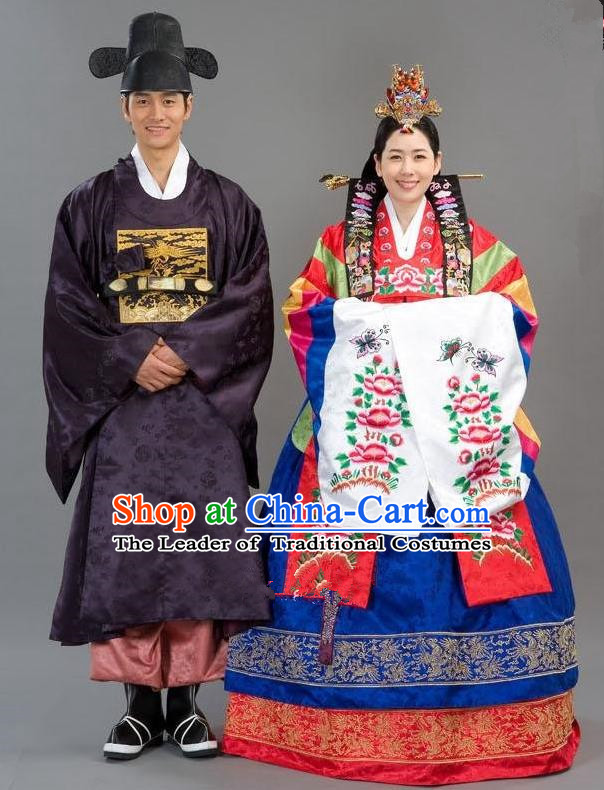
In this picture, we see a man and a woman wearing traditional Korean clothing.
They are dressed in ornate garments that exude elegance and refinement.
This attire represents a part of Korean culture and has rich historical significance and cultural connotations.
Korean traditional clothing, also known as hanbok, dates back to the year 2333 BC.
The design of hanbok is characterized by meticulous attention to detail and ornamentation, often consisting of multiple layers of clothing.
Men's hanbok includes a long robe, belt, and pants, while women's hanbok consists of an upper garment, skirt, and belt.
These garments are usually in dark or bright colors to highlight their opulence and delicacy.
Apart from its aesthetic beauty, hanbok also carries many symbolic meanings.
For example, the red-edged long robe worn by men signifies courage and strength, while the golden decorations on women's upper garments represent wealth and happiness.
Additionally, hanbok reflects the hierarchical social structure and etiquette norms in Korean society.
In conclusion, this picture showcases the beauty and uniqueness of traditional Korean clothing.
It is not merely a type of attire but a symbol of culture and a testament to history.
By appreciating and understanding hanbok, we can gain a deeper insight into Korean culture and values.
 Listen in the gallery Listen in the gallery
|




 -year leader,
 it. Or we remake it for FREE.