Delivery: 1-17 days FREE worldwide shipping Handicraft: Well handmade by top traditional tailors using top quality fabrics Size: The listed sizes are in stock. If you prefer to customize it, please select "Free Customization" and leave us a note containing your size number or measurements of height, weight, bust, waist and hip on the order form. Color: If you like the original color most, you do not need to select it or simply select "Same as the picture". If you wish to change the primary color, you may select it based on the color chart. Or you may select "Free Customization" and leave us a note containing your detail color requests on the order form. Free Customization Available: If you prefer to let our top traditional tailors specially customize it for you, please select "Free Customization" in size or color, then provide your measurements (or usual size number) and/or color requests in the order form. This special tailoring service is free. Free Urgent Delivery Available: If needed, just leave your desired date in the order notes. We will try our best to help and handle the rest at no cost!
Rich Artistic Connotation & Historical Background:
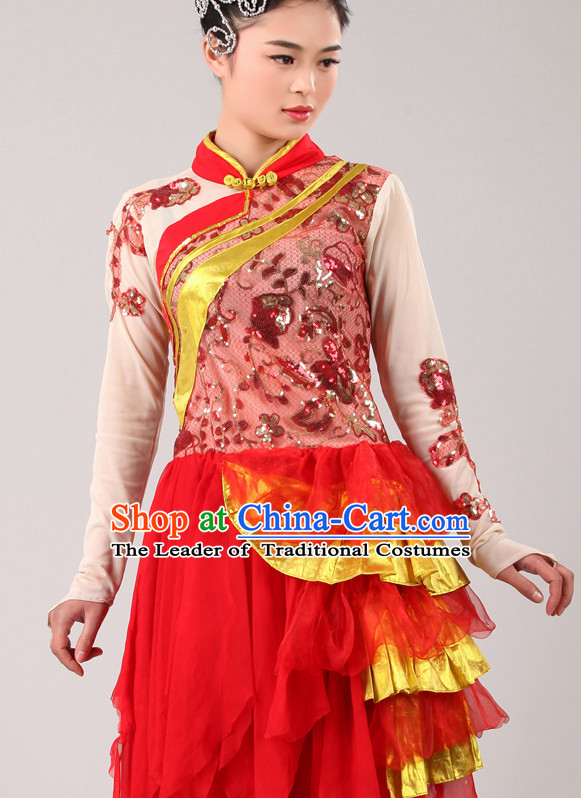
Chinese costumes, folk dance costumes, carnival costumes, formal wear and ethnic costumes as well as hair accessories are all rich and colorful elements in Chinese culture.
These artworks represent China's long history and unique cultural traditions, showcasing the Chinese people's pursuit of beauty and creativity.
Chinese costumes are world-renowned for their exquisite design, rich colors, and superb craftsmanship.
From Hanfu to Tangzhuang, and then to modern fashion, Chinese costumes have been evolving and developing.
Each costume has its unique style and characteristics, reflecting the aesthetic concepts and social status of different historical periods.
For example, Hanfu is one of the oldest costumes in Chinese history, known for its elegant lines, delicate embroidery, and loose cut.
Tangzhuang represents ancient court costumes in ancient China, famous for its gorgeous decorations and exquisite details.
Modern fashion pays more attention to comfort and practicality while retaining some traditional elements.
Folk dance costumes are another way to showcase the charm of Chinese culture.
They are usually made of silk with bright colors and unique patterns.
These costumes are worn during various festivals and celebrations such as the Spring Festival and Mid-Autumn Festival.
They not only have visual appeal but also carry rich symbolic meanings and story backgrounds.
Carnival costumes and formal wear are common elements in Western culture but also have their unique expressions in China.
These costumes are usually characterized by ornate decorations, exaggerated designs, and bold colors, aiming to attract people's attention and convey specific themes or emotions.
For example, during Halloween, people wear various horror costumes to celebrate the holiday; on weddings, brides usually wear a gorgeous wedding dress to show her beauty and happiness.
Finally, ethnic costumes and hair accessories are also important components of Chinese culture.
They are usually made of natural materials such as silk, cotton, and linen, featuring unique patterns and colors.
These costumes and hair accessories not only have practical value but also carry rich historical and cultural information.
For instance, Tibetan costumes are famous for their bright colors and complex patterns; Miao ethnic group hair accessories are loved by people for their unique shapes and materials.
In conclusion, Chinese costumes, folk dance costumes, carnival costumes, formal wear, ethnic costumes, and hair accessories are all indispensable parts of Chinese culture.
They represent the Chinese people's pursuit of beauty and creativity while reflecting the aesthetic concepts and social status of different historical periods.
By appreciating these artworks, we can better understand the rich connotations and historical significance of Chinese culture.
 Listen in the gallery Listen in the gallery
|




 -year leader,
 it. Or we remake it for FREE.