Delivery: 1-17 days FREE worldwide shipping Handicraft: Well handmade by top traditional tailors using top quality fabrics Size: The listed sizes are in stock. If you prefer to customize it, please select "Free Customization" and leave us a note containing your size number or measurements of height, weight, bust, waist and hip on the order form. Color: If you like the original color most, you do not need to select it or simply select "Same as the picture". If you wish to change the primary color, you may select it based on the color chart. Or you may select "Free Customization" and leave us a note containing your detail color requests on the order form. Free Customization Available: If you prefer to let our top traditional tailors specially customize it for you, please select "Free Customization" in size or color, then provide your measurements (or usual size number) and/or color requests in the order form. This special tailoring service is free. Free Urgent Delivery Available: If needed, just leave your desired date in the order notes. We will try our best to help and handle the rest at no cost!
Rich Artistic Connotation & Historical Background:
"Chinese Opera, including Peking Opera and Cantonese Opera, is an important part of Chinese culture.
Among them, Peking Opera is famous for its unique singing style, performance, and costumes.
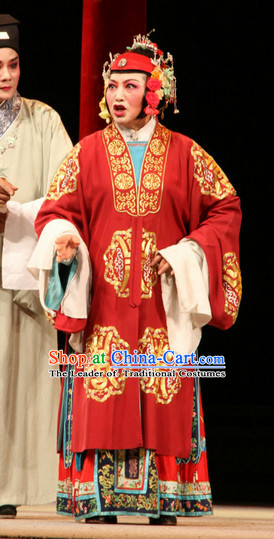
In these operas, the costumes and hair accessories of ancient Chinese rich women are also an indispensable part.
Ancient Chinese rich women usually wear luxurious clothing, including robes, pleated skirts, headwear, etc.
Their costumes are usually made of high-end fabrics such as silk and satin, with bright colors and exquisite patterns.
The most famous ones are the "Four Great Dan," namely Mei Lanfang, Cheng Yanqiu, Shang Xiaoyun, and Xun Huisheng.
Their costumes and hairstyles are also unique, showing the unique charm of ancient Chinese women.
In addition to costumes, ancient Chinese rich women also pay attention to hair decoration.
They usually comb their hair into various shapes, such as hairpins and coiled hair.
These hairstyles are not only beautiful and elegant but also show their status and position.
For example, Cixi, the Empress Dowager of the Qing Dynasty, was famous for her hairstyle.
In conclusion, the costumes and hair accessories of ancient Chinese rich women are an important part of traditional Chinese culture.
They not only reflect the aesthetic concepts and fashion trends of the society at that time but also show the unique charm and elegance of ancient Chinese women."
 Listen in the gallery Listen in the gallery
|




 -year leader,
 it. Or we remake it for FREE.